

What is a Small Modular Reactor?
Small Modular Reactor, or SMR, refers to a class of advanced nuclear fission reactors characterized by their reduced physical footprint, modular construction, and scalable deployment. SMRs are engineered to deliver electrical power outputs typically below 300 megawatts electric (MWe) per unit and are expected to be fabricated in controlled factory settings. Their compact, modular design facilitates efficient transportation, on-site assembly, and integration into diverse energy infrastructures.
Technical Features of SMRs
- Reduced Size and Power Rating: SMRs generally produce less than 300 MWe, allowing for flexible grid integration and deployment in regions with limited energy demand or infrastructure constraints.
- Modular Fabrication and Scalability: Components and reactors are standardized with most construction off-site, permitting phased installation of multiple modules to achieve desired capacity and streamline project timelines.
- Passive and Inherent Safety Systems: Many SMRs employ advanced passive safety mechanisms such as gravity-fed emergency cooling, natural convection, and fail-safe shutdown features. These eliminate reliance on external power or operator intervention during abnormal events, significantly mitigating risk profiles.
- Flexible Siting and Deployment: The reduced land, cooling water, and grid requirements enable SMRs to be sited in remote or isolated locations, on microgrids, or as replacements for legacy fossil-fueled power plants.
Operational Principles
SMRs utilize conventional nuclear fission, whereby fissile material, commonly low-enriched uranium-235, is used as fuel. Fissile material refers to any substance that can undergo nuclear fission, a process in which the nucleus of an atom splits into two or more smaller nuclei, releasing a large amount of energy. The controlled fission reaction starts with kinetic energy, which in turn releases thermal energy, which is transferred via primary coolant systems to generate steam in a secondary circuit. This steam drives turbines coupled to generators, producing electricity.
Technical advancements in SMR designs include integral pressurized water reactors (iPWRs), high-temperature gas-cooled reactors (HTGRs), and liquid metal fast reactors (LMFRs), each with unique coolant mediums, operating pressures, and neutron economy profiles. Factory fabrication of reactor pressure vessels and core modules enhances quality assurance and reduces on-site construction complexity.
Introduction to Nuclear Fission
Nuclear fission stands as one of the most significant scientific discoveries of the twentieth century, underpinning the operation of nuclear reactors and playing a crucial role in the global electricity supply. At its core, fission is a process where the nucleus of a heavy atom splits into two or more lighter nuclei, releasing a substantial amount of energy. This energy can be harnessed for electricity generation, propulsion, and a variety of other applications. In the context of Small Modular Reactors (SMRs), fission is the mechanism by which thermal energy is produced and subsequently transformed into electrical power.
The Atomic Nucleus and Nuclear Forces
To understand fission, it is essential to grasp the basics of atomic structure. Atoms consist of a central nucleus made up of protons and neutrons (collectively called nucleons), surrounded by a cloud of electrons. The nucleus is held together by the strong nuclear force, a fundamental interaction that binds protons and neutrons tightly, overcoming the electromagnetic repulsion between the positively charged protons.
Not all nuclei are equally stable. Heavy nuclei, such as uranium-235 or plutonium-239, contain many protons and neutrons. The strong nuclear force becomes less effective at the periphery, while the repulsive electromagnetic force grows with each additional proton. This delicate interplay means that certain heavy nuclei are only marginally stable and can be induced to split apart under the right conditions.
The Fission Process
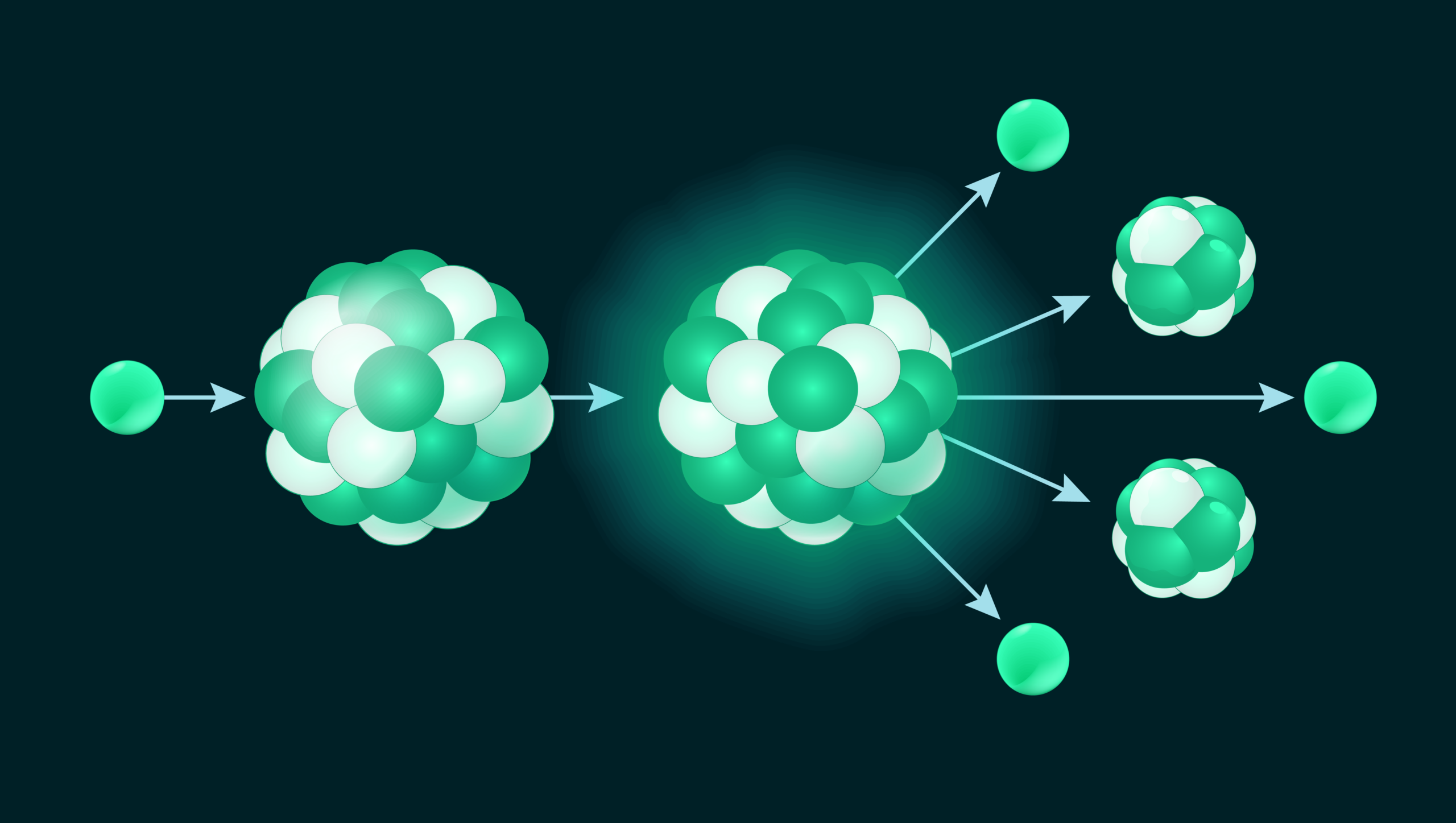
Nuclear fission typically occurs in one of two ways: spontaneously or as a result of neutron absorption. Spontaneous fission occurs naturally but very rarely in a few isotopes. An isotope is a variant of a chemical element that has the same number of protons (which defines the element) but a different number of neutrons in its nucleus. This means isotopes of an element have the same atomic number, but different mass numbers. The process of interest in nuclear reactors is induced fission, which is triggered when a heavy nucleus captures a neutron.
- Neutron Absorption: When a fissile nucleus, such as uranium-235, absorbs a neutron, it becomes unstable. The resulting compound nucleus is in an excited state with excess energy.
- Nucleus Splitting: This unstable nucleus quickly deforms and oscillates, elongating until the nuclear forces can no longer counteract the electrostatic repulsion. The nucleus splits into two smaller nuclei, known as fission fragments.
- Release of Neutrons: In addition to the two fission fragments, several (typically two or three) free neutrons are emitted during the process.
- Energy Liberation: The mass of the resulting products is less than that of the original nucleus and the absorbed neutron. According to Einstein’s equation (E=mc²), the missing mass is converted into energy.
Products of Fission
The immediate products of a fission event include:
- Fission Fragments: These are the two medium-weight nuclei resulting from the split. They are typically radioactive isotopes of elements such as barium, krypton, strontium, and xenon.
- Prompt Neutrons: The two or three neutrons liberated can go on to initiate further fission events, a key feature for sustaining a chain reaction.
- Energy: The energy released per fission event is around 200 mega-electron-volts (MeV), distributed mainly as kinetic energy of the fragments, with smaller amounts as kinetic energy of neutrons, prompt gamma radiation, and, later, beta and gamma radiation from radioactive decay.
Potential Applications in the Energy Sector
- Remote and Off-Grid Power Generation: SMRs can supply reliable, baseload power to isolated communities, mines, or military installations where conventional grid connectivity is challenging.
- Integration with Renewables and Smart Grids: Their rapid startup and load-following capabilities allow SMRs to support intermittent renewable sources and stabilize microgrid operations.
- Process Heat and Desalination: Certain SMR designs provide high-temperature steam for industrial applications, hydrogen production, or seawater desalination.
In summary, SMRs represent a paradigm shift in nuclear energy by combining advanced safety features, modular scalability, and versatile siting options. Their technical innovations offer a pathway for secure, efficient, and low-carbon power generation to meet evolving global energy requirements.